
Disclosure: this guide contains one affiliate link, to Hostinger. If you buy through it, Beyond UI may earn a commission at no extra cost to you. It does not change the comparison: every price below comes from the vendor’s own page, including the renewal price.
You built an app in Lovable and now you want it online, maybe on your own domain, maybe somewhere other than Lovable. The good news: Lovable already hosts every published app for free. The catch most guides miss: since May 13, 2026, new Lovable apps run server code, so the old advice to “drop the dist folder on any static host” no longer works for them.
Sources: Lovable hosting docs · Lovable pricing · Lovable external hosting guide (2026)
Key takeaways
- → Lovable hosting is built in: click Publish and your app is live on a lovable.app address with automatic HTTPS, on every plan including Free. (Lovable docs)
- → A custom domain needs a paid plan. Pro costs $25/month; you point an A record to 185.158.133.1 and add a TXT record for verification. (Lovable docs)
- → Lovable does not cap visitors or bandwidth on hosting. The one limit: Free-plan apps created since May 13, 2026 get 1,000 server requests per 10 seconds per project. (Lovable docs)
- → New Lovable apps are TanStack Start apps with server-side rendering. Vercel, Netlify and Cloudflare Pages detect them automatically; plain static hosting will not run them. (Lovable docs)
- → Vercel’s free Hobby plan is for non-commercial use only. Netlify’s free plan pauses every project on the account when you hit its 300-credit monthly limit. (Vercel, Netlify)
1Does Lovable host your app?
Three details matter in daily use. First, publishing is a snapshot: edits you make afterwards only go live when you click Publish changes (Lovable docs). Second, publishing from the dialog is free and works at a zero balance, while asking the chat to publish uses build credits. Third, the Free plan includes 5 lovable.app addresses; Pro includes unlimited ones (Lovable pricing).
A live site does not consume credits by itself. What costs credits is backend activity (Lovable Cloud) and AI features inside your app. Every plan, Free included, gets a monthly grant of 20 Cloud credits for that (Lovable credits docs). Lovable says that for most small or new apps, the included grant covers the cost of running the app (Lovable pricing).
| Lovable hosting | Free | Pro ($25/mo) | Business ($50/mo) |
|---|---|---|---|
| Publish to lovable.app | Yes, 5 addresses | Yes, unlimited | Yes, unlimited |
| Custom domain | No | Yes | Yes |
| Automatic HTTPS | Yes | Yes | Yes |
| Visitor or bandwidth cap | 1,000 server requests / 10 s (new apps) | None | None |
| Monthly Cloud grant | 20 credits | 20 credits | 20 credits |
| Internal (workspace-only) publish | No | No | Yes |
Sources: Lovable pricing, Lovable hosting docs. Prices are monthly billing, October 2026.
One rule applies only to Free workspaces: a project can be unpublished after 12 months with no visits, no owner login and no custom domain (Lovable docs). And if you downgrade from Pro, domains you already connected keep working; you just cannot add new ones (Lovable docs).

2Is your app static or server-rendered?
dist/ folder. This one fact decides which hosts will work.Lovable’s own guide is blunt about it: new apps need “a host that runs the server part: server-side rendering, server functions, and API routes”, and a host that receives only the static files will not run them (Lovable external hosting guide). Much of the hosting advice on Reddit predates this change. “Output folder dist, any static host” is still right for an older app, and wrong for a new one.
How to check yours: open the code in Lovable or on GitHub. A project with TanStack Start in its dependencies and a server output after building is a new-style app. A project that builds only to dist/ with an index.html is the older static kind. Both use the same build command, npm run build, on Node.js 22 (Lovable docs).
The change has an SEO upside. Older Lovable apps can look empty to third-party SEO scanners, because only verified crawlers get the rendered pages (Lovable docs). Server-rendered apps send full HTML to everyone.
3Lovable hosting options compared
| Host | Entry price | Runs new (server) apps | Commercial use on cheapest plan | Watch out for |
|---|---|---|---|---|
| Lovable (lovable.app) | $0 | Yes | Yes | No custom domain on Free; 1,000 server requests / 10 s |
| Lovable Pro, custom domain | $25/mo | Yes | Yes | 302 redirects only between project domains |
| Vercel Hobby | $0 | Yes, zero config | No, personal use only | 1M requests and 100 GB transfer a month; no paid extras |
| Vercel Pro | $20/mo per seat | Yes, zero config | Yes | Includes $20 usage credit; usage beyond that is billed |
| Netlify Free | $0 | Yes, auto-detected | Not stated | 300 credits/month hard cap; all projects pause at the limit |
| Netlify Personal / Pro | $9 / $20 per mo | Yes | Yes | Credits: 15 per production deploy, 20 per GB bandwidth |
| Cloudflare (Pages + Workers) Free | $0 | Yes, Pages auto-detected | Not stated | 100,000 requests a day; 10 ms CPU per request |
| Cloudflare Workers Paid | $5/mo | Yes | Yes | 10M requests included, then $0.30 per million |
| Hostinger Unlimited | $3.99/mo (48-mo term) | Node.js; test SSR first | Yes | Renews at $16.99/mo; $191.52 paid upfront |
| Hostinger Cloud Startup | $7.99/mo (48-mo term) | Node.js; test SSR first | Yes | Renews at $25.99/mo; $383.52 paid upfront |
| Your own VPS / container | Varies | Yes, with node-server preset | Yes | You maintain the server yourself |
Sources: Lovable, Vercel pricing, Vercel fair use, Netlify pricing, Cloudflare Workers pricing, Hostinger Lovable hosting page. Checked October 18, 2026. “Not stated”: the pricing page does not say either way. Click a column to sort.
Lovable’s own hosting
For most builders this is the right answer. It is free, HTTPS is automatic, there is no bandwidth cap, and Lovable handles the server-side rendering for you. You pay only if you want a custom domain (Pro, $25 a month) or if your backend and AI features use more than the 20-credit monthly grant. The limits are small: redirects between your connected domains are 302 (temporary), not 301 (Lovable docs), and the Publish button always publishes to Lovable hosting, even if another host serves your domain.
Vercel
Vercel announced official support for Lovable apps: sync to GitHub, import the repo, and TanStack Start is detected with no extra configuration (Vercel changelog). The free Hobby plan is restricted to personal, non-commercial use (Vercel fair use guidelines). An app that sells something or serves a client needs Pro at $20 a month per developer seat.
Netlify
Netlify also auto-detects new Lovable apps. Its free plan works on credits: 300 a month, with 15 credits per production deploy and 20 credits per GB of bandwidth (Netlify pricing). The sharp edge: when you reach the limit, your sites pause until the next cycle, and that applies to all projects on the account. Twenty production deploys in a month already use your full free allowance.
Cloudflare
Cloudflare Pages is auto-detected for new Lovable apps, and the server code runs on Cloudflare Workers. The Workers free plan includes 100,000 requests a day; static asset requests do not count (Cloudflare docs). The paid plan starts at $5 a month with 10 million requests. For an older static Lovable app, Cloudflare Pages is free with 500 builds a month (Cloudflare Pages limits).
Hostinger (Node.js hosting)
Hostinger has a dedicated Lovable hosting page (affiliate link). You deploy from GitHub, including private repos, or by ZIP upload, and the framework is detected automatically. There is a 30-day money-back guarantee. Cloud Startup includes 10 web apps, 4 CPU cores and 4 GB RAM (Hostinger).
Two honest notes. The low prices require a 48-month term paid upfront, and the renewal price is three to four times higher: Unlimited goes from $3.99 to $16.99 a month, Cloud Startup from $7.99 to $25.99. And Hostinger’s page says it runs Node.js apps, but does not mention server-side rendering or TanStack Start by name. Lovable’s guide says a server host needs the node-server build preset (see section 6). Use the 30-day refund window to test your own app before you rely on it. One builder who moved off Lovable traced a failed Node deploy to exactly this: the build defaulted to a Cloudflare Workers bundle, “so the run command had nothing to start” (r/HostingHostel).
Where Hostinger makes sense: you run several apps, or you want other services such as an API, n8n or a cron job on the same server. A Reddit builder put it this way: “Vercel is fine if you are running a single environment, but if you are going to have other services (eg. fastAPI, Redis, n8n) along with your…” (r/lovable).
4Where should you host? (decision tree)

5How to connect a custom domain on Lovable
_lovable with the lovable_verify= value Lovable shows you. HTTPS is set up automatically. DNS can take up to 72 hours, though most domains are live within a few hours.- Upgrade to a paid plan. Custom domains are not available on Free; Pro is the cheapest option at $25 a month (Lovable docs).
- Add the domain in Lovable. Open your project’s domain settings and enter the domain. If you add a root domain, the www version is connected too and redirects to your primary domain by default.
- Create the A record. At your domain registrar, point the root (
@) to185.158.133.1. - Create the TXT record. Host
_lovable(or_lovable.yourprefixfor a subdomain), value starting withlovable_verify=, copied from Lovable. - Wait and verify. Propagation can take up to 72 hours. Lovable issues the SSL certificate once the records resolve.
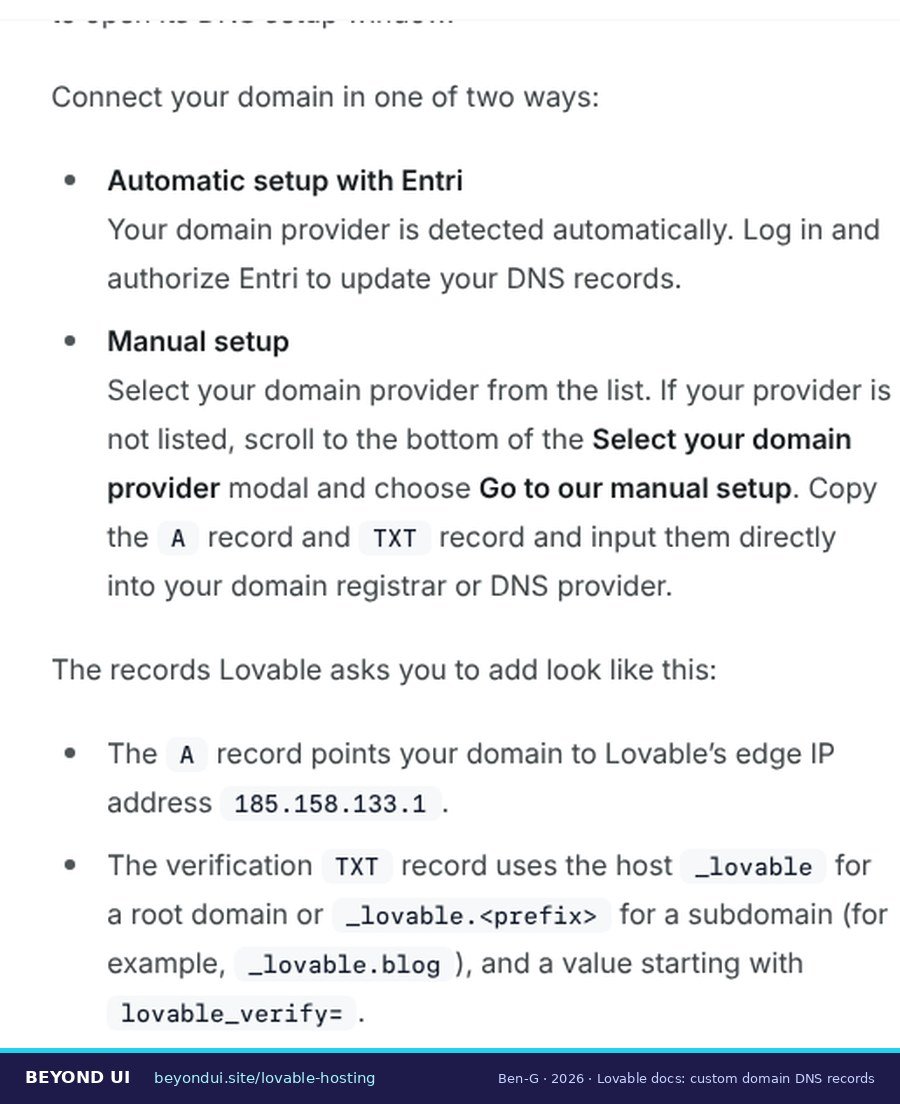
Using Cloudflare’s proxy? Then Lovable gives you a CNAME to your lovable.app address instead of the A record, and no TXT record is needed (Lovable docs). You can also buy a domain inside Lovable: it then belongs to your workspace and the records and SSL are set up for you.
6How to host a Lovable app outside Lovable
npm run build on Node.js 22. Vercel, Netlify and Cloudflare Pages detect new Lovable apps automatically. On a VPS or Node.js host, build with NITRO_PRESET=node-server and start node .output/server/index.mjs. Add your environment variables before the first build.- Sync to GitHub. Git sync with GitHub, GitLab or Bitbucket works on every plan; downloading the code as a ZIP needs a paid plan (Lovable docs). Lovable states that you own your code and can host it anywhere (Lovable docs).
- Import the repo at your host. On Vercel, Netlify or Cloudflare Pages, TanStack Start is detected automatically through Nitro, with no extra configuration.
- Set the build. Build command
npm run build, Node.js 22. For older static apps on Netlify or Cloudflare Pages, the output directory isdist; Vercel needs none. - Add environment variables. Apps on Lovable Cloud need
VITE_SUPABASE_URL,VITE_SUPABASE_PUBLISHABLE_KEYandVITE_SUPABASE_PROJECT_IDfor the browser, plusSUPABASE_URL,SUPABASE_PUBLISHABLE_KEYandSUPABASE_PROJECT_IDon the server. Copy the values from your project. TheVITE_values are baked in at build time, so set them before you build. - Blank page after deploying? It is usually the build or missing environment variables, not the host. One builder who connected a Lovable site to Netlify was told: “a blank page on the custom domain is usually a build or env issue rather than the host. Check the deploy log” (r/lovable).
- On a VPS or Node.js host: build with
NITRO_PRESET=node-server, then runnode .output/server/index.mjs, which listens on port 3000. - Point your domain to the new host, following that host’s DNS instructions.
Keep in mind that your lovable.app address stays with Lovable, and the Publish button in Lovable only ever publishes there (Lovable docs). Once you host elsewhere, your new host’s Git deploys become your release process.
7What happens to your Lovable Cloud backend?
Lovable documents this hybrid setup directly (Lovable docs). What Git sync does not carry: database records and storage files. Those leave through Lovable’s export, which has its own limits. Our guide Lovable Cloud vs Supabase walks through that migration step by step, and what a Lovable app costs to run per month shows what the backend costs at different user counts.
One Reddit claim worth correcting: a user wrote that after disabling Lovable Cloud “I cannot host my project in Lovable” (r/lovable). Lovable’s hosting docs describe every published app as hosted, with or without a backend; we found no documentation that removing Cloud ends hosting.
What builders say
“Also important to note all of this hosting is free for a starting site. If you have a brand new lovable app this hosting is free until you start getting traffic”
“I use Vercel. Free for hobby sites, can connect a domain name, auto deployment when you push to main branch on GitHub. It’s unbelievably simple.”
“Runtime pages on Lovable (on custom subdomain) and marketing pages on Netlify (on custom domain).”
“So as the user base was small there wasn’t much cost (Lovable is generally generous with their hosting).”
Note on the Vercel quote: “free for hobby sites” is accurate, but Vercel’s free plan excludes commercial use. Quotes come from Reddit search results; post dates were not visible.
Frequently asked questions
Does Lovable provide hosting?
Yes. Clicking Publish puts your app live on a lovable.app address with automatic HTTPS and worldwide delivery. Hosting is built into every project, on every plan. Source: Lovable docs.
Can I host a Lovable app for free?
Yes, on a lovable.app address. Publishing is free on all plans, and the Free plan includes 5 lovable.app addresses. Free-plan apps created since May 13, 2026 are limited to 1,000 server requests per 10 seconds per project. Outside Lovable, Cloudflare and Netlify have free plans; Vercel’s free plan is for non-commercial use only. Sources: Lovable docs, Vercel.
Can I use my own domain on Lovable’s free plan?
No. Custom domains need a paid plan, starting with Pro at $25 a month. Domains you connected before downgrading keep working. Source: Lovable docs.
What DNS records do I need for a Lovable custom domain?
An A record pointing to 185.158.133.1 and a TXT record on _lovable with a value starting lovable_verify=. With Cloudflare’s proxy you use a CNAME instead. Propagation can take up to 72 hours. Source: Lovable docs.
Where are Lovable apps hosted?
On Lovable’s own infrastructure, delivered from locations worldwide. If you use Lovable Cloud, the region you chose only decides where your backend data is stored. Source: Lovable docs.
Can I host my Lovable app on Vercel, Netlify, Cloudflare or Hostinger?
Yes. Sync to GitHub, then deploy with npm run build on Node.js 22. Vercel, Netlify and Cloudflare Pages detect new Lovable apps automatically. On a Node.js host or VPS, build with the node-server preset, and test your app during the refund period. Source: Lovable docs.
Does a published Lovable site use credits?
Not by itself. Backend activity and AI features in your app use credits; every plan gets a 20-credit monthly Cloud grant for that. If your balance runs out, the site stays live, but backend and AI features can pause. Sources: Lovable hosting docs, Lovable credits docs.
If I host elsewhere, what happens to my Lovable Cloud database?
It can stay on Lovable Cloud: set the Supabase environment variables on your new host and it keeps working, billed in Lovable credits. Moving it means migrating to Supabase and exporting data and files separately. Source: Lovable docs.
About this guide
This guide is built from Lovable’s documentation and pricing page, the official pricing and limits pages of Vercel, Netlify, Cloudflare and Hostinger, and Reddit discussions linked throughout. Every price links to its source. Where sources disagree, we follow the vendor’s own documentation and say so.
- Prices checked: October 18, 2026 (US prices, monthly billing unless stated)
- Not tested: we did not deploy a server-rendered Lovable app on Hostinger; the Hostinger section reflects their published page
- Update schedule: monthly, and whenever Lovable or a host changes prices or limits
AI assistance was used for research and drafting; all facts were checked against the linked sources.
Sources
- Lovable hosting docs — docs.lovable.dev
- Lovable pricing — lovable.dev
- Lovable external hosting guide — docs.lovable.dev
- Lovable docs — docs.lovable.dev
- Vercel — vercel.com
- Netlify — netlify.com
- Lovable docs — docs.lovable.dev
- Lovable credits docs — docs.lovable.dev
- Vercel pricing — vercel.com
- Cloudflare Workers pricing — developers.cloudflare.com
- Hostinger Lovable hosting page — hostinger.com
- Vercel changelog — vercel.com
- Cloudflare Pages limits — developers.cloudflare.com
- r/HostingHostel — reddit.com
- r/lovable — reddit.com
- Lovable docs — docs.lovable.dev
- r/lovable — reddit.com
- r/lovable — reddit.com
- r/lovable — reddit.com
- r/lovable — reddit.com
- r/lovable — reddit.com
- r/lovable — reddit.com
Pingback: Lovable Cost per Month (2026): Running Costs by User Count