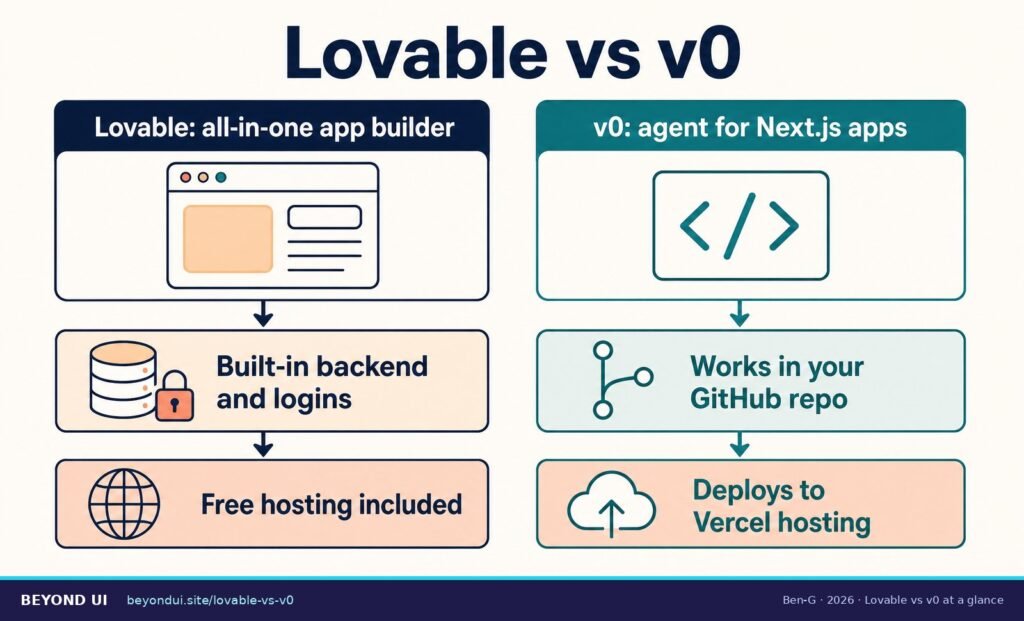
Every number below was checked against both vendors’ docs and pricing pages on November 14, 2026. Reddit posts are labelled as user reports. No affiliate ties.
Sources: v0 pricing docs, Lovable plans, lovable.dev/pricing (checked November 14, 2026)
Key takeaways
- → v0 is a full-stack agent now, with Marketplace databases and server code running in previews. (how v0 changed)
- → Both vendors’ comparison pages are partly wrong: Lovable’s calls v0 frontend-only; Vercel’s says Lovable import is “rolling out”. (vendor claims)
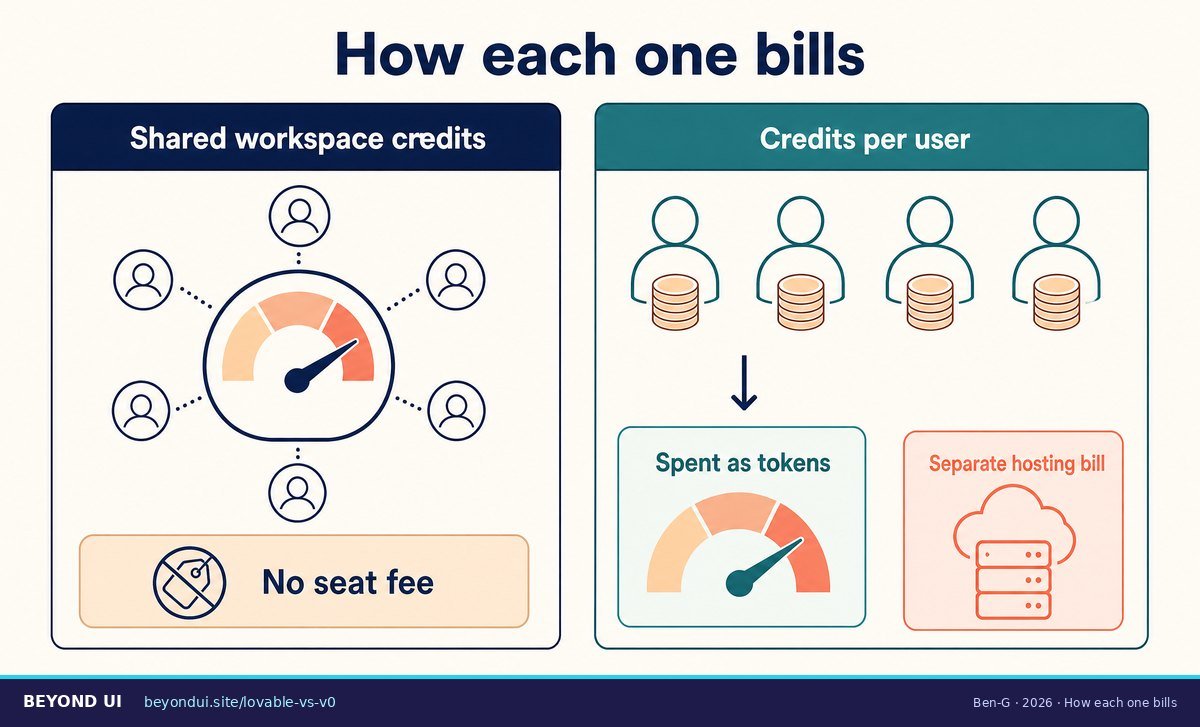
- → v0 bills twice: the v0 plan plus your Vercel plan; v0’s own example is $20 + $20 = $40 a month. (pricing)
- → Git is v0’s edge, backend is Lovable’s: v0 works inside an existing repo; Lovable includes database and auth. (Git, backend)
Lovable vs v0 at a glance
| Dimension | Lovable | v0 by Vercel |
|---|---|---|
| What it is | Full-stack AI development platform | AI agent for code, full-stack apps and agents |
| Default framework | TanStack Start (server-side rendering) since May 13, 2026 | Next.js with React, TypeScript, Tailwind, shadcn/ui |
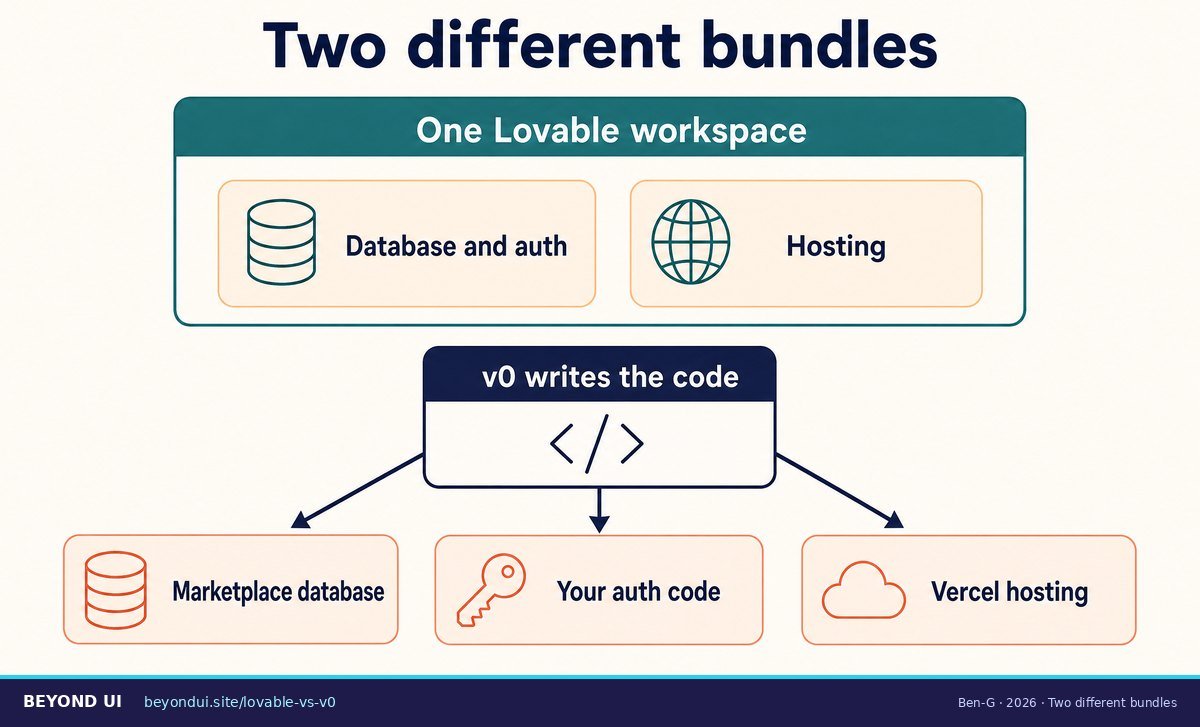
| Backend | Built-in Cloud backend, or your own Supabase | Vercel Marketplace: Supabase, Neon, Upstash, Blob |
| Auth | Managed, part of the built-in backend | Generated code on an integration or library |
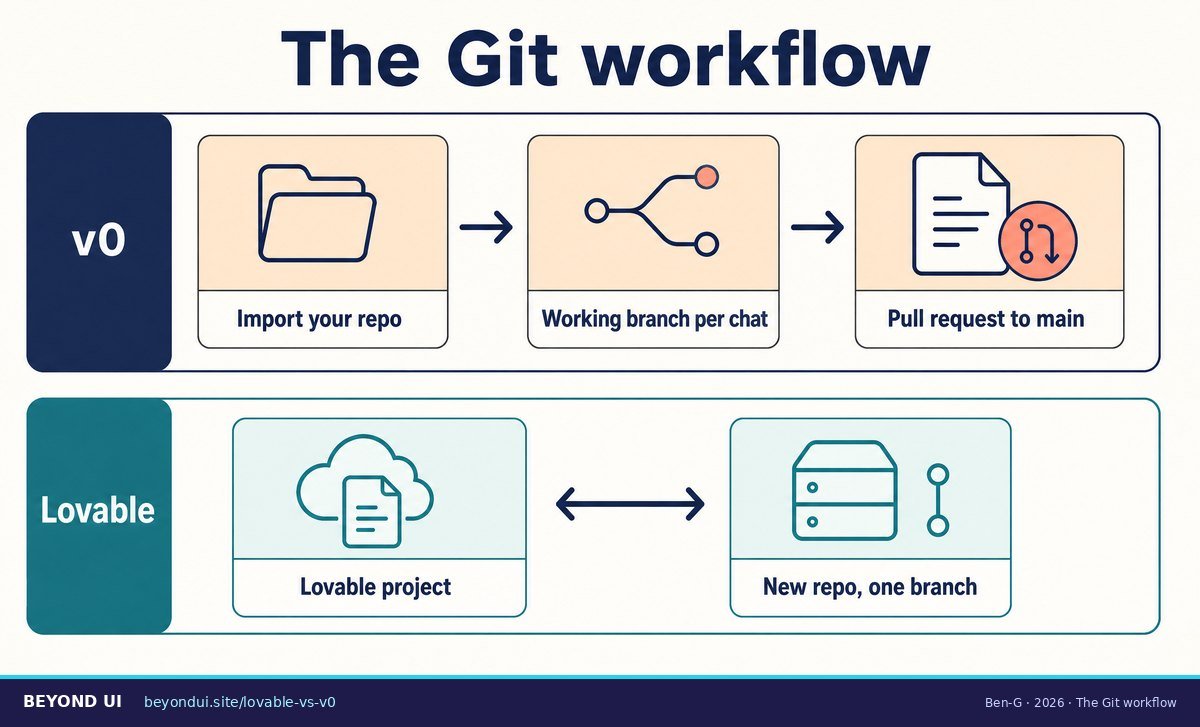
| Git | GitHub, GitLab or Bitbucket; new repo; one branch | GitHub; imports existing repos; branch per chat, pull requests |
| Hosting | lovable.app, free on all plans | Vercel, billed on your Vercel plan |
| Pricing unit | Credits per workspace, unlimited members | Dollar credits per user, spent as tokens |
| Builder apps | iOS and Android | iOS; no Android app documented |
Sources: Lovable welcome, Lovable TanStack Start, What is v0?, v0 full-stack apps, v0 FAQ.
How v0 changed: from components to a full-stack agent
- Previews run real backends. Since the February 4, 2026 update, previews run in Vercel Sandbox, a lightweight VM with server code, API routes and databases (v0 FAQ).
- The agent does more than write files: web search, browser use, automatic error fixing, terminal commands and MCP tools (agentic features).
- Plans were reshuffled: Premium “is in the process of being sunsetted” (v0 pricing docs).
Lovable moved too: TanStack Start for new projects since May 13, 2026 (June 22, 2026 on Enterprise), a preview toolbar instead of Visual edits, and Build, Plan and Chat modes.
What each vendor gets wrong about the other
| Claim | By | Our verdict |
|---|---|---|
| v0 output stays in the frontend; database, auth, backend and hosting are your job | Lovable | Contradicted: v0 builds full-stack Next.js apps with Marketplace databases, server code in previews and one-click Vercel hosting |
| v0 Premium about $20, Team about $30 per user; covers “UI generation only” | Lovable | Outdated: Premium is closed to new users, the $30-per-user team plan is now listed as Plus (one docs page still says “Team”), Business is $100 per user, credits pay for full-stack work |
| Going live on v0 means connecting Vercel, configuring env vars, and manually setting DNS for custom domains | Lovable | Misleading: publish is one click to vercel.app and integrations add env vars automatically; custom-domain DNS is needed on Lovable too |
| Lovable runs on a Supabase integration; modes are Agent, Chat, Visual Edits | Lovable | Partly outdated: default is the built-in Cloud backend; modes are Build, Plan, Chat |
| Lovable Pro starts at $25 a month for unlimited users | Lovable | Confirmed |
| Lovable import is “rolling out” and may not appear in every account | Vercel | Disagrees with Lovable’s docs: available on all plans |
| Lovable has no framework choice or Next.js; Git sync makes a new repo, one branch; editing and full ZIP are paid | Vercel | Confirmed |
| v0 Figma import is paid; Lovable’s .fig upload doesn’t import designs or components | Vercel | Confirmed |
| v0 plans are Free, Plus, Business, Enterprise | Vercel | Consistent with the pricing page; docs also list closed Premium |
Sources: lovable.dev guide, vercel.com article, v0 docs, Lovable import docs.
Backend, auth and database
Lovable. The built-in Cloud backend has a database, storage, authentication, realtime and functions, managed by Lovable and built on Supabase open source (Cloud docs). You can connect your own Supabase instead, on any plan. Built-in payments (Paddle or Stripe) need Pro or higher. Backend usage spends credits, and at zero credits Cloud-backed apps pause. See our Lovable Cloud vs Supabase guide.
v0. Adding a database integration “provisions a new user account” at the provider and adds the environment variables (v0 databases). Options are Supabase, Neon, Upstash and Vercel Blob, plus Stripe for payments. v0 builds apps with authentication, but documents no managed auth service: auth is generated code, for example on Supabase. In-app AI uses the Vercel AI Gateway by default.
Code and Git workflow
v0. Import a public or private repo you can access, monorepos included; each chat gets its own working branch. v0 “never pushes directly to main”: Publish creates or reuses a pull request, merges it and waits for production, and branch protection applies (v0 GitHub docs, import from GitHub). Each branch gets a Vercel preview. Deleting the repo can make code unrecoverable. The editor handles files up to 1 MB; ZIP uploads cap at 10 MB on Free and 50 MB on paid plans.
Lovable. Two-way sync with GitHub, GitLab or Bitbucket on every plan, but linking “creates a new repository” and it edits one branch at a time (Lovable GitHub docs). Editing code needs a paid plan (Free is read-only), as does a full ZIP download. Existing apps come in by import: Replit, Bolt, v0, Base44, Manus or a ZIP of up to 250 MB, rebuilt on TanStack Start, on all plans (import docs).
Ownership. Vercel “doesn’t own the code generated” by v0; Lovable says you’re never locked in.
Design and frameworks
Framework. v0 defaults to Next.js; other frameworks work, but its docs say Next.js is most reliable. Lovable documents no Next.js option. If your team standardises on Next.js, that decides it. Lovable’s server-side rendering narrows the SEO gap a Reddit user cited for picking v0 (user report).
Visual editing. v0’s Design Mode is on Free but not on mobile viewports (Design Mode). Lovable’s preview toolbar spends credits on selecting and drawing, with 100 free inline text edits that renew 24 hours after use (preview toolbar).
Figma. v0 reads a pasted file or frame link (frames, tokens, layout, text, assets), paid plans only (v0 Figma). Lovable has a Figma plugin (Dev seat or higher), the Figma MCP via both desktop apps, and a .fig upload that “does not recreate your designs or components” (Lovable Figma). Neither builds native mobile apps.
Hosting and going live
Lovable publishes to lovable.app with HTTPS on all plans; custom domains need a paid plan (Lovable hosting). A live site uses no credits by itself; Run credits cover what the app does, helped by a 20-credit monthly Cloud grant. Self-hosting works with a server, and Nitro presets detect Vercel, Netlify and Cloudflare Pages. More in our Lovable hosting guide.
v0 makes a preview deployment per working branch and a production deployment on publish, each with a free vercel.app URL (v0 deployments). Vercel Hobby includes 100 GB Fast Data Transfer, 1,000,000 CDN requests and 4 CPU-hrs a month; Pro adds $20 of usage credit (Vercel pricing, Hobby plan). You can export and deploy elsewhere, but the full experience needs a Vercel project.
Pricing: credits vs token-priced dollars
v0 plans
| Plan | Price | Included credits | Notes |
|---|---|---|---|
| Free | $0 | New users $5 once; existing Free users $5 a month | 7 messages a day; can’t buy credits |
| Premium | $20 a month | $20 a month | Closed to new users |
| Plus | $30 per user a month | $30 per user | Team collaboration; all members are Builders |
| Business | $100 per user a month | $30 per user | Training opt-out by default |
| Enterprise | Custom | Custom | Role-based access; no daily login credits |
Premium, Plus and Business add $2 of daily login credits per user, expiring at the end of the UTC day. Purchased credits expire one year after purchase and need an active paid plan. Sources: v0 pricing docs, v0.app/pricing.
v0 token rates
| Per 1M tokens | Input | Cache write | Cache read | Output |
|---|---|---|---|---|
| v0 Mini | $0.20 | $0.25 | $0.02 | $1.20 |
| v0 Pro | $2 | $2.50 | $0.20 | $10 |
| v0 Max | $5 | $6.25 | $0.50 | $25 |
| v0 Max Fast | $10 | $12.50 | $1 | $50 |
Input includes chat history, source files and Vercel context; Max Fast has 2.5x faster output. Source: v0.app/pricing.
Our arithmetic: $30 of credits buys 3M output tokens on v0 Pro, or 25M on v0 Mini, if every token were output. Real prompts also pay for input, including your files, so bigger projects cost more per prompt.
Lovable plans
| Plan | Monthly | Annual (100 credits) | Included | Top-ups |
|---|---|---|---|---|
| Free | $0 | n/a | 5 daily credits (max 30 a month); 20 Cloud, 4 AI, 1 connector credit a month | None |
| Pro | $25 (100 credits) to $2,250 (10,000) | $250 ($21 a month) | Monthly credits, 5 daily credits, same grants | $15 per 50 credits |
| Business | $50 (100 credits) to $4,300 (10,000) | $500 ($42 a month) | As Pro, plus SSO and training exclusion by default | $30 per 50 credits |
| Enterprise | Contact sales | Contract | Volume-based credits | Per contract |
Unlimited members on all plans; priced by credits, not seats. Sources: Lovable plans, credits and usage, top-ups. How credits get spent: our Lovable credits explainer.
v0’s own contradictions: the docs say unused credits “expire after 65 days”, the pricing FAQ says they roll over “for one month”. The FAQ says “No, we do not offer discounts”, yet v0 for Students gives verified students at participating US universities $20 of credits a month for 1 year, and v0.app/pricing shows Plus at $30 next to a struck-through $90.
Monthly cost estimator
What users report
| Thread | Date | What they reported | Leans |
|---|---|---|---|
| v0 or Lovable? | December 10, 2025 | v0 for SEO and less lock-in, Lovable for non-coders | Mixed |
| Is v0 dead? | March 31, 2026 | Misses daily free messages; credit billing feels pricier | Lovable |
| So expensive | April 2, 2026 | Edits on a large project cost $100 a day; replies: model cost, not hosting | Neither |
| Lovable vs Bolt.new vs v0 in 2026 | May 10, 2026 | Lovable for a SaaS MVP, v0 for Vercel-native teams | Both |
| Is v0 still available? | May 26, 2026 | A Vercel employee explains credits; a user calls v0 7-10x pricier than rivals | Neither |
| Why use apps like Lovable? | May 29, 2026 | Builders remove deploy, database, auth and hosting chores | Both |
| Same prompt in six builders | August 9, 2026 | No clear winner (below) | Neither |
| PSA: v0 just reset unused credits | October 4, 2026 | Unused credits reset after an account change (below) | Lovable, in replies |
“if you’re just mocking screens, v0’s chill. if you want something that behaves like an app, lovable.”
r/lovable, December 2025 (predates v0’s full-stack docs)
“What used to cost around $20 for an entire month of building now feels like $20 per hour.”
r/v0_, March 2026
“The value isn’t always the model. It’s removing 20 little headaches around the model.”
r/vibecoding, May 2026
Who should pick which
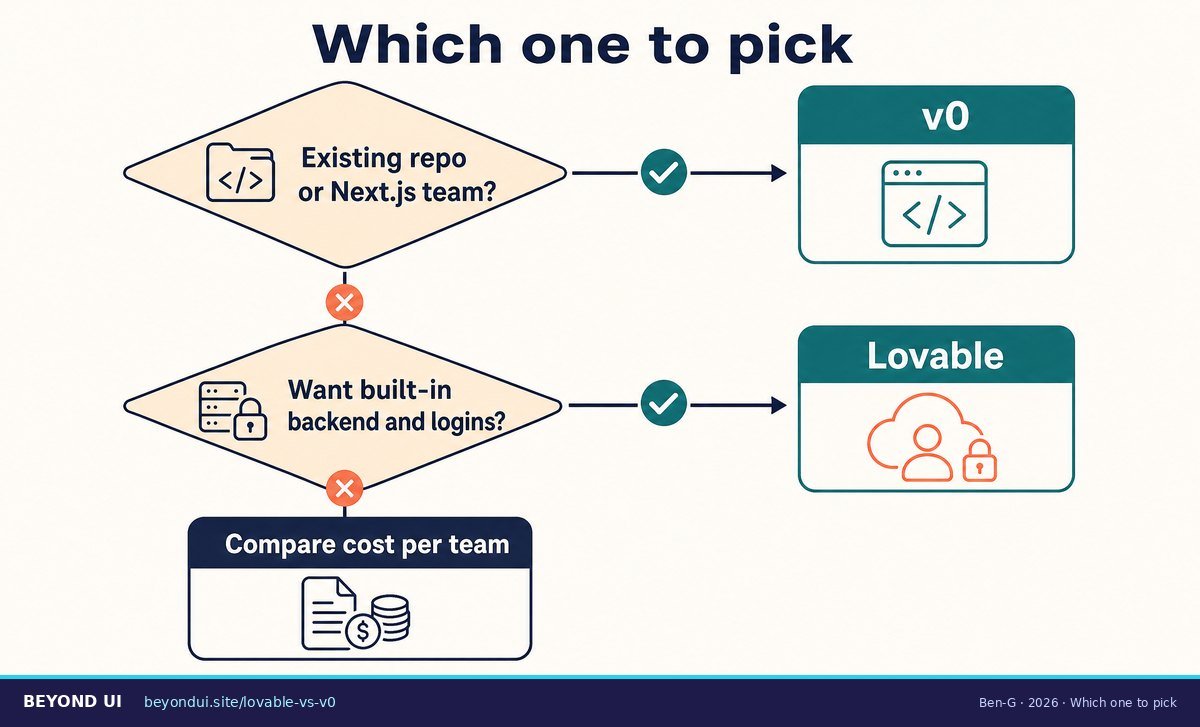
- Pick Lovable if you can’t code or don’t want to run a backend. The whole team shares one credit balance. Free gets 5 daily credits (up to 30 a month); Pro starts at $25.
- Pick v0 if your app lives in GitHub, your team writes Next.js, or you already pay for Vercel. Pull requests per chat fit code review; Plus is $30 per user.
- Need SSO? Lovable Business (from $50) has SSO and role-based access; on v0, role-based access is Enterprise-only.
- Switching later: Lovable imports v0 projects; there’s no live sync between them.
See also Lovable vs Cursor, Lovable vs Bolt and Replit vs Lovable.
Frequently asked questions
Is v0 better than Lovable?
Neither wins outright. v0 suits Next.js teams with a GitHub repo on Vercel; Lovable suits builders who want backend, auth and hosting included at one price for the team. Sources: v0 GitHub docs, Lovable Cloud docs.
Is v0 still just a UI component generator?
No. v0’s docs describe an agent for full-stack apps, with Marketplace databases and previews that run server code in Vercel Sandbox. Sources: What is v0?, v0 FAQ.
How much does v0 cost compared with Lovable?
v0 Plus is $30 and Business $100 per user a month, each with $30 of credits per user. Lovable Pro is $25 for 100 credits and Business $50, with unlimited members. Sources: v0 pricing docs, Lovable plans.
Do I pay for Vercel hosting on top of v0?
Yes, billing is separate. Hobby is $0; v0’s own example is a one-member Vercel Pro team ($20) plus v0 Premium ($20), $40 a month. Sources: v0.app/pricing, Vercel pricing.
Does v0 have a backend and auth like Lovable?
v0 connects Supabase, Neon, Upstash or Blob through the Vercel Marketplace and generates auth code; it has no managed auth service. Lovable’s built-in backend includes auth. Sources: v0 full-stack apps, Lovable Cloud.
Can either work with my existing GitHub repo?
v0 can: it imports public and private repos and works through branches and pull requests. Lovable’s Git sync always creates a new repo; existing code comes in as a ZIP import. Sources: v0 import from GitHub, Lovable GitHub docs.
Does Lovable use Next.js?
No. New Lovable projects use TanStack Start since May 13, 2026, with no Next.js option documented; v0 defaults to Next.js. Sources: Lovable TanStack Start, v0 full-stack apps.
What happens when I run out of credits?
On v0, generation pauses; paid plans can buy more, Free must upgrade. On Lovable, building and in-app AI stop and Cloud-backed apps pause. Sources: v0 pricing docs, Lovable credits and usage.
About this comparison
Written by Ben-G, a practitioner who builds with AI app builders and checks every number against vendor docs; no affiliate ties with Lovable or Vercel. On November 14, 2026 we fetched v0’s full docs, pricing and students pages, Vercel’s pricing and Hobby pages, Lovable’s docs and both vendors’ comparison pages, and read 20 Reddit threads.
- Our arithmetic: team totals, token counts and the estimator.
- Not in the docs: a typical v0 cost per prompt, v0 annual prices and API pricing, the number of free daily “Fix with v0” uses (blank), Marketplace provider prices, and any head-to-head speed or quality benchmark.
- Also inconsistent: which v0 plans can buy credits (docs vs FAQ).
AI assistance was used for research and drafting; all facts were checked against the linked sources.
Sources
- v0 pricing docs — v0.app
- Lovable plans — docs.lovable.dev
- lovable.dev/pricing — lovable.dev
- Lovable welcome — docs.lovable.dev
- Lovable TanStack Start — docs.lovable.dev
- What is v0? — v0.app
- v0 full-stack apps — v0.app
- v0 FAQ — v0.app
- agentic features — v0.app
- lovable.dev guide — lovable.dev
- vercel.com article — vercel.com
- v0 docs — v0.app
- Lovable import docs — docs.lovable.dev
- Cloud docs — docs.lovable.dev
- v0 databases — v0.app
- v0 GitHub docs — v0.app
- import from GitHub — v0.app
- Lovable GitHub docs — docs.lovable.dev
- Design Mode — v0.app
- preview toolbar — docs.lovable.dev
- v0 Figma — v0.app
- Lovable Figma — docs.lovable.dev
- Lovable hosting — docs.lovable.dev
- v0 deployments — v0.app
- Vercel pricing — vercel.com
- Hobby plan — vercel.com
- v0 Teams docs — v0.app
- v0 Vercel integration — v0.app
- v0.app/pricing — v0.app
- credits and usage — docs.lovable.dev
- top-ups — docs.lovable.dev
- v0 for Students — v0.app
- v0 or Lovable? — reddit.com
- Is v0 dead? — reddit.com
- So expensive — reddit.com
- Lovable vs Bolt.new vs v0 in 2026 — reddit.com
- Is v0 still available? — reddit.com
- Why use apps like Lovable? — reddit.com
- Same prompt in six builders — reddit.com
- PSA: v0 just reset unused credits — reddit.com