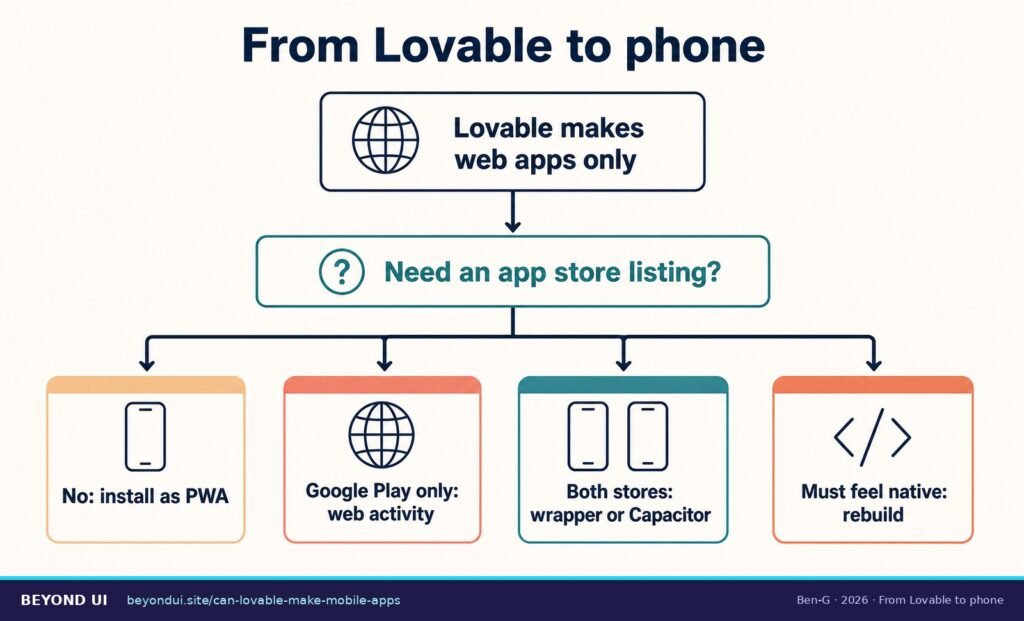
Can Lovable make mobile apps? Not native ones. Lovable builds web apps that work well on a phone, but it does not produce an iOS or Android app you can upload to the App Store or Google Play. That still leaves six realistic ways onto phones, from a free installable web app to a full React Native rebuild. They differ a lot in cost, effort and how likely Apple is to accept them.
Sources: Lovable FAQ · Lovable publish docs (2026)
Key takeaways
- → Lovable publishes to a web URL only. It documents two ways onto phones: an installable web app (PWA), or a Capacitor native shell built outside Lovable. (Lovable docs)
- → The Lovable mobile app, launched on April 27, 2026, is an editor for building from your phone. It does not turn your project into a native app. (Lovable blog, Lovable docs)
- → Store fees are the same on every route: $99/year for Apple and $25 once for Google Play. (Apple, Google)
- → Apple’s guideline 4.2 asks for apps that go “beyond a repackaged website”. A bare web wrapper is the classic rejection. (App Review Guidelines)
- → New personal Google Play accounts must run a closed test with 12 testers for 14 days before going live. (Google Play Console Help)
1Can Lovable make mobile apps?
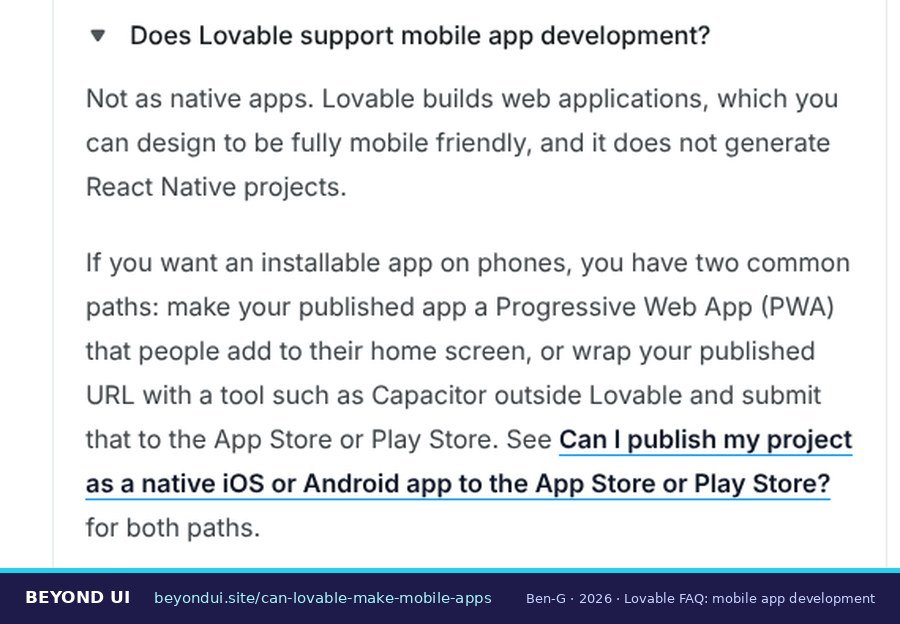
Lovable’s docs are direct about this. The FAQ says it “does not generate React Native projects” (Lovable FAQ), and the publish docs say there is “no built-in flow that packages and submits your project to the App Store or Google Play” (Lovable publish docs). For the web side, see our guide to Lovable hosting.
The same page names two official ways forward. The first is a home-screen install with offline support, which Lovable calls “the fastest path”. The second is to “wrap your published URL in a native shell with Capacitor outside of Lovable” and submit that shell to the stores, which Lovable calls “the right path when you need access to native device APIs (camera, push notifications, biometrics, etc.)”. For true React Native, its advice is to prototype in Lovable and rebuild outside it (Lovable docs).
What the Lovable mobile app is, and isn’t
On April 27, 2026, Lovable announced it “is now available on iOS and Android” (Lovable blog). The app lets you prompt by voice or text and get notified when a build is ready, and is meant “to complement the desktop experience, not replace it” (Lovable mobile app docs). The publish docs are explicit: it “does not turn your project into a native app” (Lovable docs).
Lovable even admits the gap in its comparison with Emergent, which outputs Expo and React Native code: “Native mobile is the clearest gap between the two” (Lovable guide). Building your screens in Lovable still makes sense; our breakdown of how many credits it takes to build an app helps you budget that part.
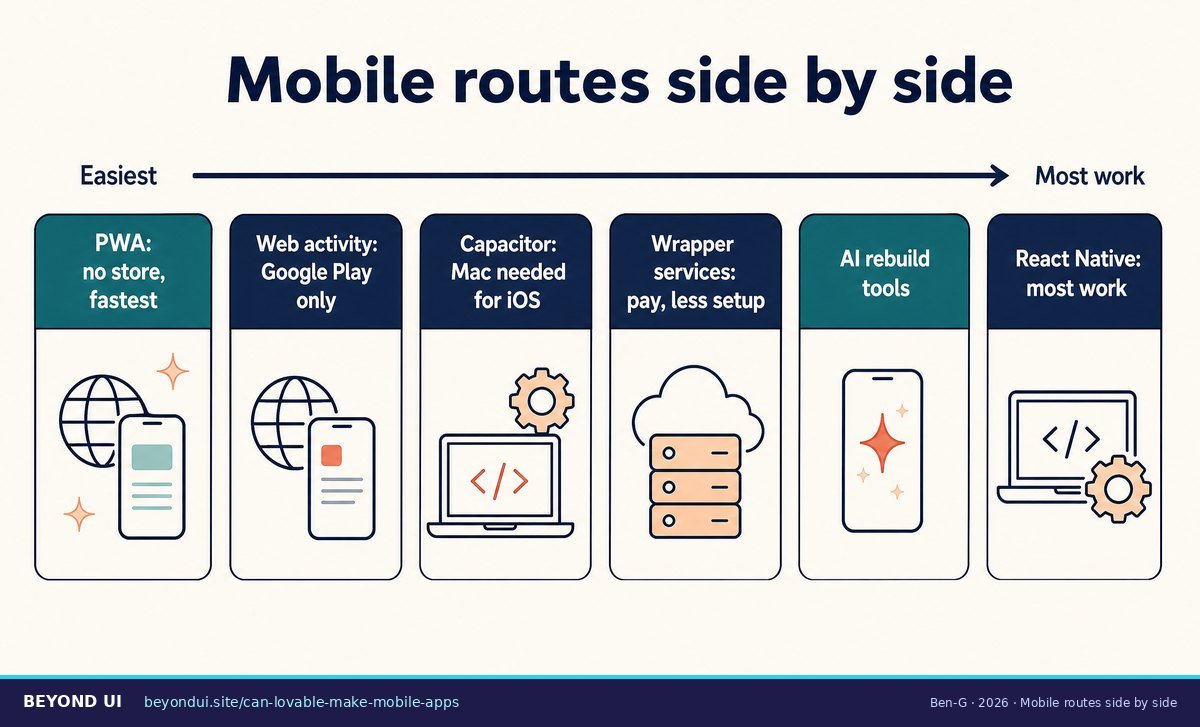
2The 6 routes at a glance
| Route | First-year cost | Time | Needs a Mac | App Store / Google Play | Push | Offline |
|---|---|---|---|---|---|---|
| 1. PWA | $0 | Fastest, no review | No | No listing | Android yes; iPhone only from Home Screen, iOS 16.4+ | Yes, per Lovable |
| 2. Trusted Web Activity | $25 | Not stated; plus 14-day Play test | No (Android only) | Google Play only | As the PWA, on Android | As the PWA |
| 3. Capacitor (DIY) | $124 | Not stated; one builder: 10-20 hours | Yes, for iOS | Both, subject to review | Yes, native APIs | Depends on your build |
| 4a. Natively | $268 | Not stated | Not stated; automatic iOS upload | Both, paid plans | Yes, paid plans | Not stated |
| 4b. Median.co Starter | $353 | Not stated | Not stated | Both | OneSignal, FCM plugins | Not stated |
| 4c. Despia Hybrid Pack | $622 | Under 60 min (vendor claim) | Not stated | Both | OneSignal, local push | Not stated |
| 5. AI rebuild (Newly) | $424 | Not stated | No, with Expo cloud builds | Both | Not verified | Not verified |
| 6. React Native by hand | $124 | Not stated | No, with Expo cloud builds | Both | Not verified | Not verified |
First-year cost = Apple $99 + Google $25 where both stores apply, plus the cheapest qualifying vendor plan: Natively Essential billed yearly, Median Starter activation, Despia for both platforms, Newly billed annually. Checked October 30, 2026. “Not stated”: the vendor’s pages do not say. Click a column to sort.
The cheap routes either skip the stores or cost you time and a Mac. Wrapper services sell the opposite trade: money instead of setup work. Only Despia gives a time figure, its own “under 60 minutes” (Despia), which excludes review.
3Route by route: cost, fit and the catch
1. Progressive web app (PWA)
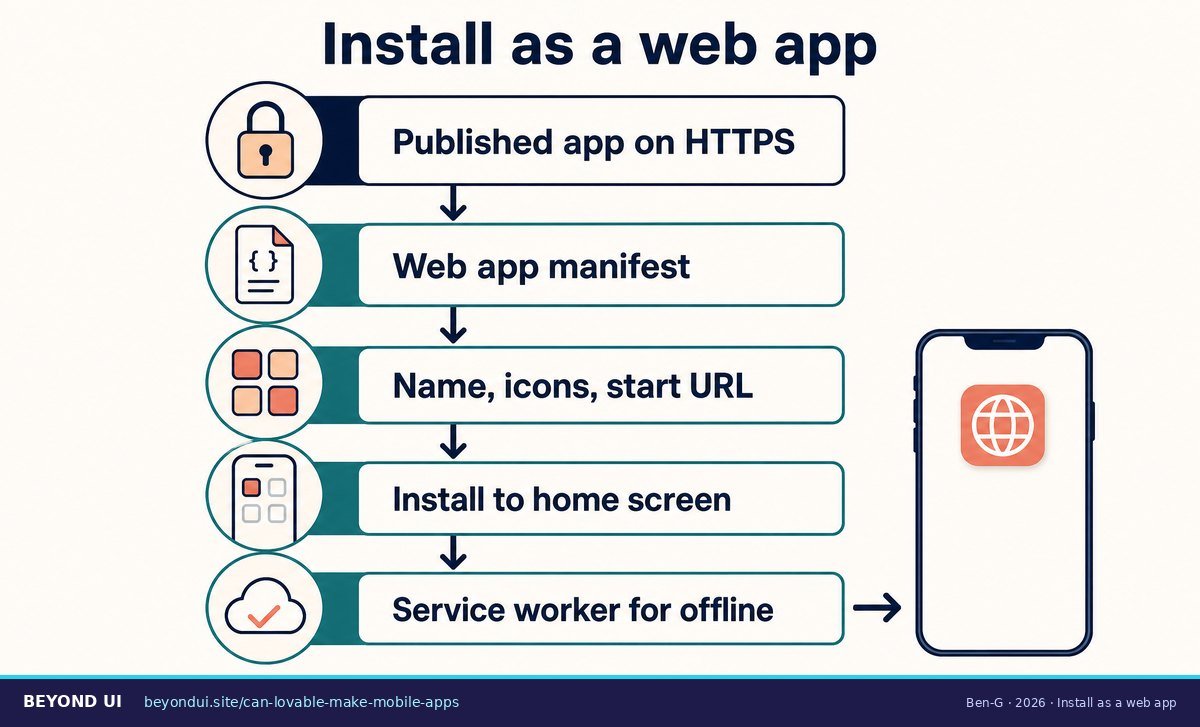
Your published app, made installable: an icon, a full-screen view and offline support (Lovable docs). Lovable’s Android guide notes it “can be installed as a PWA on any Android device” straight from Chrome (Lovable Android guide).
Chrome’s current install criteria are HTTPS plus a web app manifest with a name or short_name, a 192px and a 512px icon, a start_url and a display mode (web.dev); MDN agrees (MDN). Neither lists a service worker as an install requirement. You still want one for offline use, because that is the job a service worker does.
Cost: $0 beyond your Lovable plan. Suits: internal tools, client portals, MVPs, apps people reach through a link. The catch: no App Store listing, and limited push on iPhone. Apple added web push in iOS and iPadOS 16.4, but only for “Home Screen web apps”, and the permission request must follow “direct user interaction” such as a tap (WebKit). A visitor who never installs your app gets no notifications.
2. Trusted Web Activity for Google Play (PWABuilder)
A thin Android package around your PWA. Lovable’s Android guide says a TWA “lets you wrap your web app and submit it to Google Play without rebuilding natively”, and points to PWABuilder (Lovable Android guide). That guide (May 6, 2026) never mentions Capacitor.
Cost: Google’s $25 one-time fee (Google). Suits: Android-first apps that want to be found in Google Play. The catch: nothing for iPhone, every PWA limit still applies, and new personal accounts face the two-week closed test in section 4.
3. Capacitor: build the native shell yourself
The route Lovable’s docs recommend for store apps. Capacitor is “an open source native runtime” (Capacitor) that runs web apps “natively on iOS, Android, and more” (Capacitor docs). You export your code, add Capacitor, and build in Xcode and Android Studio, adding plugins for push or device features.
Cost: Capacitor is free; the store fees of $99 a year (Apple) and $25 once (Google) make $124 in year one. Suits: builders with a Mac who don’t mind a terminal. Capacitor 8 needs Xcode 26.0+, Android Studio 2025.2.1+ and Node.js 22+ (Capacitor setup), and Xcode runs only on macOS. The catch: the work is real. One builder reported “about $10 of credits, 10-20 hours of my time” for a simple App Store app (r/lovable). And a shell that only loads your site is exactly what guideline 4.2 targets.
4. Wrapper services: Median, Despia, Natively
Paid services that build the native shell and add plugins such as push. Prices are the vendors’ own.
- Median.co: Free plan with a “Powered by Median.co” watermark. Starter is $229 one-time plus a $179 annual fee, which Median says starts in 12 months; Essential $590 plus $399 a year; Plus $990 plus $669 a year. Turnkey publishing, where Median submits for you, starts on Business at $7,200 a year (Median pricing).
- Despia: says it gets a web app native “in under 60 minutes”. Solo Pack $249 one-time for iOS or Android; Hybrid Pack $498 for both, with source code export. Features include RevenueCat paywalls, OneSignal and local push, and store payments (Despia). Prices are from Despia’s homepage; its /pricing page returned a 404 on October 30, 2026.
- Natively: the Free plan cannot build binaries or publish. Essential is $19 a month or $12 billed yearly; Unlimited $49 or $32 billed yearly; Lifetime $699 once (Natively pricing). Essential lists both “Unlimited builds” and “Includes 4 rebuilds. Extra build: $9 each”, so count on 4. Natively’s “100% app store release guarantee” is the vendor’s promise, not Apple’s.
Suits: builders who want the stores without the setup work. The catch: a wrapper does not change what Apple reviews. If the app is still your website in a frame, 4.2 applies regardless of who built the frame.
5. AI rebuild tools: CatDoes and Newly
AI builders that produce real React Native code instead of wrapping your site. CatDoes says you can “paste a URL from Lovable” and its agent “ships a native mobile app” built with Expo (CatDoes). Newly says it “outputs React Native code” that compiles to native iOS and Android components (Newly).
Cost: Newly starts at $25 a month billed annually, with publishing to the App Store and Google Play (Newly pricing). CatDoes lists Starter, its first tier with store publishing, at $42 a month (CatDoes pricing), but its own cost breakdown says $50 a month, or $42 billed yearly. Budget $50 if you pay monthly. Suits: apps that must feel native. The catch: it is a rebuild, so you maintain two codebases and rewire your backend. If your data sits on Lovable Cloud, read Lovable Cloud vs Supabase first.
6. Rebuild in React Native by hand (Expo)
Lovable’s own advice: prototype “your app’s screens and flows in the browser, then rebuild them with React Native outside of Lovable” (Lovable docs). With Expo’s EAS Build, “iOS builds run on macOS runners hosted in Expo’s macOS cloud” (Expo docs), so you need no Mac for the build step.
Cost: $124 in store fees in year one, plus a lot of developer time. The catch: the most work of the six; your Lovable project becomes a design reference.
4Will Apple reject a wrapped Lovable app?
The text in Apple’s App Review Guidelines, last updated October 16, 2026 (Apple):
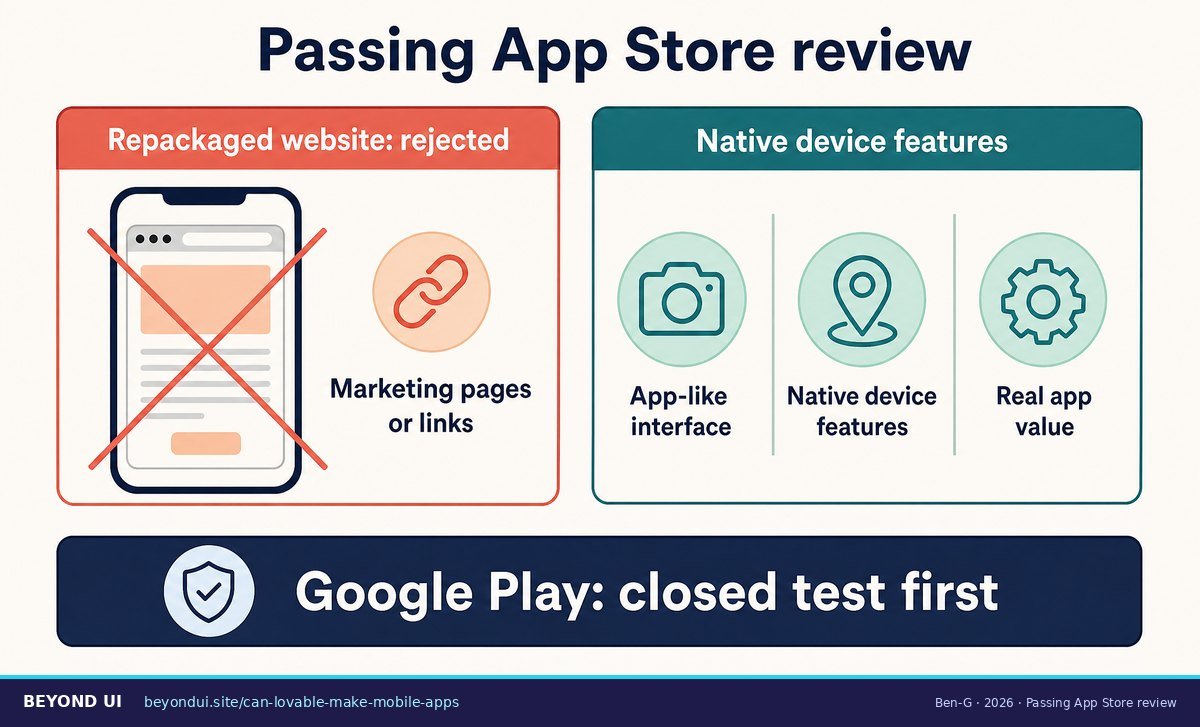
- 4.2 Minimum Functionality: “Your app should include features, content, and UI that elevate it beyond a repackaged website. If your app is not particularly useful, unique, or ‘app-like,’ it doesn’t belong on the App Store.”
- 4.2.2: “Other than catalogs, apps shouldn’t primarily be marketing materials, advertisements, web clippings, content aggregators, or a collection of links.”
One Lovable builder was “rejected twice now on Guideline 2.1.0 and 4.2.0 (App Completeness, Minimum Functionality)” (r/capacitor).
What helps you pass
Apple publishes no checklist, so none of this is guaranteed:
- Use native device features. Lovable points to Capacitor for camera, push notifications and biometrics (Lovable docs). One builder who shipped to both stores used Capacitor “with native features (push, Apple/Google …” (r/lovable).
- Make the interface feel like an app. The guideline names “features, content, and UI”.
- Don’t count on one feature. Outside Lovable, a WebView app was “rejected despite my adding a token system and push notifications” (r/iOSProgramming), and another was rejected under 4.2.2 “for about a month before the first approval” (r/iOSProgramming).
- Finish the app first. The first rejection above also cited 2.1, App Completeness.
Google Play’s 14-day closed test
Personal developer accounts created after November 13, 2023 “must run a closed test for their app with a minimum of 12 testers”, each “opted in continuously for the preceding 14 days”, before production access (Google Play Console Help).
5What it costs to publish
| Metric | Value | Source |
|---|---|---|
| Apple Developer Program | $99 per year | Apple |
| Google Play registration | $25 one-time | |
| Capacitor | Free, open source | Capacitor |
| Natively Essential / Lifetime | $12/month billed yearly / $699 one-time (vendor) | Natively |
| Median Starter | $229 one-time + $179 annual fee starting in 12 months (vendor) | Median |
| Despia Solo / Hybrid Pack | $249 / $498 one-time (vendor) | Despia |
| Newly Apex | $25/month billed annually (vendor) | Newly |
| CatDoes Starter | $42/month listed; $50/month in its blog (vendor) | CatDoes |
US prices, checked October 30, 2026. Vendor prices may change.
In year two, Despia costs nothing more, Median’s $179 fee starts, and Apple’s $99 returns. Your Lovable plan and backend keep running underneath any route; see what a Lovable app costs to run per month.
If the app stores are the deciding factor, note that Base44 has a built-in App Store and Google Play submission flow (a web-view wrapper; the store files need its Builder plan). We compare it with Lovable’s routes in Base44 vs Lovable.
6Which route should you pick? (decision tree)
Selling products in the app? See our Lovable Shopify guide. Connecting outside tools while you build? See Lovable MCP.
What builders say
“About $10 of credits, 10-20 hours of my time, and I got a simple app to the App Store.”
“I built it with Lovable as a web app, wrapped it with Capacitor, and shipped it to both Android and iOS with native features (push, Apple/Google …”
“Their tool takes your vibe coded app and turns it into a mobile native app. The process itself was super easy to follow (we submitted within 24h)”
“Turning a loveable project into a real iOS app is HARD.”
Note: “submitted within 24h” refers to submission, not approval. Quotes come from Reddit search results; post dates were not visible.
Frequently asked questions
Can Lovable make mobile apps?
Not native ones. Lovable builds mobile-friendly web apps and does not generate React Native projects. It documents two paths: a PWA, or a Capacitor wrapper built outside Lovable. Sources: Lovable FAQ, Lovable docs.
Can I put a Lovable app on the App Store or Google Play?
Yes, but not from inside Lovable. Wrap it with Capacitor, use a wrapper service such as Median, Despia or Natively, or rebuild it in React Native. Sources: Lovable docs, Lovable Android guide.
How much does it cost to get a Lovable app into the app stores?
Store fees are $99 a year for Apple and $25 once for Google: $124 in year one. Capacitor is free. Wrapper services start at $12 a month billed yearly (Natively), $229 plus a $179 annual fee starting in 12 months (Median) or $249 per platform (Despia), all vendor prices. Sources: Apple, Google, Despia.
Will Apple reject a wrapped Lovable web app?
It can. Guideline 4.2 asks for apps that go “beyond a repackaged website”, and 4.2.2 rules out web clippings. Builders report 4.2 rejections for thin WebView wrappers. Source: App Review Guidelines.
Does Lovable have a mobile app?
Yes, on iOS and Android since April 27, 2026. It is an editor for prompting and reviewing builds from your phone, not a way to turn your project into a native app. Sources: Lovable blog, Lovable docs.
Should I use a PWA or a native wrapper?
Start with a PWA if you don’t need a store listing; Lovable calls it the fastest path. Go native if you need the App Store, native device APIs, or iPhone push for people who haven’t added the app to their Home Screen. Sources: Lovable docs, WebKit.
Do I need a Mac to publish a Lovable app to iOS?
Why does Google Play make me wait two weeks?
Personal accounts created after November 13, 2023 must run a closed test with at least 12 testers, opted in for 14 continuous days, before production access. Source: Google Play Console Help.
About this guide
Sources: Lovable’s docs and guides, Apple and Google developer documentation, Capacitor, Expo, web.dev, MDN and WebKit docs, vendor pricing pages, and the Reddit threads linked throughout. Vendor prices are labelled as such, and where a vendor’s own pages disagree, both figures are shown.
- Last verified: October 30, 2026 (US prices)
- Not tested: no Lovable app was submitted to either store for this guide
- Update schedule: monthly, and whenever Lovable, Apple, Google or a listed vendor changes rules or prices
AI assistance was used for research and drafting; all facts were checked against the linked sources.
Sources
- Lovable FAQ — docs.lovable.dev
- Lovable publish docs — docs.lovable.dev
- Lovable blog — lovable.dev
- Apple — developer.apple.com
- Google — support.google.com
- App Review Guidelines — developer.apple.com
- Google Play Console Help — support.google.com
- Lovable mobile app docs — docs.lovable.dev
- Lovable guide — lovable.dev
- Natively — buildnatively.com
- Median — median.co
- Despia — despia.com
- Newly — newly.app
- Lovable Android guide — lovable.dev
- web.dev — web.dev
- MDN — developer.mozilla.org
- WebKit — webkit.org
- Capacitor — capacitorjs.com
- Capacitor docs — capacitorjs.com
- Capacitor setup — capacitorjs.com
- r/lovable — reddit.com
- CatDoes — catdoes.com
- CatDoes pricing — catdoes.com
- cost breakdown — catdoes.com
- Expo docs — docs.expo.dev
- r/capacitor — reddit.com
- r/lovable — reddit.com
- r/iOSProgramming — reddit.com
- r/iOSProgramming — reddit.com
- r/lovable, about Despia — reddit.com
- r/lovable — reddit.com